Yoga.orgTeach Reserve your seat
Draft v0.1 · Open for comment

The Yoga.org Teaching Standard

What a certified teacher must be able to demonstrate. Not how long they sat in a room — what they can actually do. Published in full, before you enroll, and readable by anyone deciding whether to hire you.

Why we don't count hours

Every other program sells a number: 200 hours, 300 hours, 500 hours. An hour count measures attendance. It tells a studio how long you were present and nothing about whether you can safely lead a room. It also makes it impossible to credit what you already know — if the credential is the hours, then skipping ahead is cheating.

We measure competencies instead. That single change is what makes the rest of this program work: your path is built from the competencies you can't yet demonstrate, you test out of the ones you can, and certification means a named human confirmed you meet the standard. The standard is the product. The modules are just how you get there.

How it's assessed

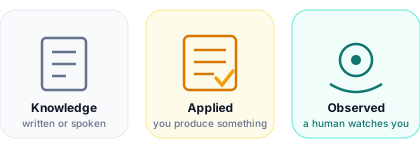
The three assessment types: Knowledge, Applied and Observed

Every competency below is assessed in one of three ways, marked on each line:

  • Knowledge — assessed by written or oral response. Testable out: demonstrate it up front and skip the module.
  • Applied — assessed by a produced artifact: a sequence, a class plan, an intake form, a recorded cue. Reviewed against a rubric.
  • Observed — assessed by a named faculty member watching you teach. Never testable out, never automated. This is the part that makes the credential mean something.

You are certified when every competency is met. Not when a clock runs out. Most candidates take about twelve weeks; an experienced practitioner may take less, and someone who needs longer takes longer without penalty.

A · Practice and technique

9 competencies
A1

Demonstrate and name the foundational asana

Correct form, common misalignments, and the Sanskrit and English names

Knowledge
A2

Explain the function of a pose

What each pose is for — not just its shape — and what it prepares the body for

Knowledge
A3

Offer at least two variations for any pose

Scaled up and scaled down, with props, for a body that can't do the standard shape

Applied
A4

Identify the six principles of alignment in a live body

Looking at a person, not a diagram

Observed
A5

Teach foundational pranayama safely

Technique, benefits, and the conditions under which each is contraindicated

Applied
A6

Lead a guided meditation or relaxation

Pacing, language, and holding silence without filling it

Observed
A7

Sequence a complete class with a coherent arc

Warm-up, peak, counterpose, close — with a stated intention the sequence actually serves

Applied
A8

Adapt a sequence live when the room requires it

Someone arrives injured, the room is colder or more experienced than expected

Observed
A9

Sequence for your specific teaching mode

A mixed-level room and a single body over twelve weeks are different problems

Applied

B · Anatomy and safety

7 competencies · medically reviewed
B1

Describe the major joints and their safe ranges

Spine, shoulder, hip, knee, ankle, wrist — and what loads each tolerates

Knowledge
B2

Explain what happens in the body during a given pose

Which structures are loaded, lengthened, and compressed

Knowledge
B3

State the contraindications for common conditions

Pregnancy, hypertension, glaucoma, disc injury, joint replacement, osteoporosis

Knowledge
B4

Screen a new student before they practice

The questions to ask, and how to ask them without practicing medicine

Applied
B5

Recognize when to refer out

The single most important safety competency: knowing what is not yours to treat

Observed
B6

Spot an unsafe alignment while a class is moving

Without stopping the room, and without singling anyone out

Observed
B7

Respond appropriately to a student in distress

Faintness, panic, pain, or a medical event mid-class

Applied

C · Teaching craft

6 competencies
C1

Cue a pose verbally while people are already moving

Short, specific, actionable — and audible from the back of the room

Observed
C2

Teach without demonstrating

Because you can't watch the room and be in the pose at the same time

Observed
C3

Give a correction that lands and doesn't shame

Including whether to correct at all, and whether to do it publicly

Observed
C4

Ask for and honour consent for physical touch

Where touch is used at all. Opt-in, revocable, and never assumed

Observed
C5

Hold a room

Presence, pacing, managing the late arrival and the dominant student

Observed
C6

Teach effectively through a camera

For online paths: framing, sound, and cueing a body you can only partly see

Observed

D · Philosophy, history and context

5 competencies
D1

Trace yoga's development to the present day

Including the parts of the modern story that are recent inventions

Knowledge
D2

Explain the eight limbs and their source

From Patanjali's text, not from a paraphrase of a paraphrase

Knowledge
D3

Pronounce and translate the Sanskrit you use

If you say it in a class, you can say what it means

Knowledge
D4

Bring a philosophical theme into a class without preaching

Relevant, brief, and optional for the student who came only to move

Applied
D5

Teach a tradition you didn't grow up in, respectfully

Attribution, context, and the difference between appreciation and costume

Knowledge

E · Ethics and scope

4 competencies
E1

State the boundary of your scope of practice

You are not a physiotherapist, a psychologist, or a doctor

Knowledge
E2

Manage the power dynamic between teacher and student

Including dual relationships, gifts, and the student who wants more from you

Knowledge
E3

Teach a trauma-aware class as a baseline

Invitational language and choice, not a specialization but a default

Applied
E4

Handle a complaint or a boundary violation

Your own, or one you witness

Knowledge

F · Professional practice

5 competencies · the part usually left out
F1

Set and justify your rates

For your market, your mode, and your experience — and hold them

Applied
F2

Produce the paperwork you're legally expected to have

Intake form, liability waiver, and appropriate insurance in your jurisdiction

Applied
F3

Get through a studio audition

What they're actually assessing, and how a schedule really gets filled

Applied
F4

Describe what you teach so the right student recognizes it

Your listing, your bio, and the words a searching student actually types

Applied
F5

Run the business end without dread

Booking, payment, cancellations, no-shows, and records

Applied

36 competencies · 12 of them observed by a human

Twelve competencies can only be met by a named faculty member watching you teach and deciding you meet the standard. They cannot be tested out of, automated, or bought. If someone tells you their certification is equivalent, ask them how many of their requirements a human being personally verified.

The question you're going to ask

"Is this a 200-hour training? Is it Yoga Alliance registered?"

No to both, and you deserve a straight answer about what that means.

Yoga Alliance is a private US trade association that maintains a registry of schools and teachers who pay it annual dues. It is not a government accreditor and it does not examine individual teachers. Its 200-hour standard is a curriculum-hours framework: schools submit a syllabus showing hours allocated across categories.

We deliberately don't fit that framework, because it counts the wrong thing. But you should know the practical consequences before you enroll:

  • Some studios and gyms specifically require RYT-200 registration. If that's the job you want, our credential does not substitute for it, and we won't pretend otherwise.
  • Some insurers ask about it. Many will cover you on other evidence of training; check before you rely on it.
  • Many employers don't ask at all — especially for private clients, corporate work, online teaching, and studios that audition you rather than read your paperwork.

Our bet is that a published standard with named human review, that a studio owner can actually read, is worth more over time than a number that describes attendance. That's a bet, and you're entitled to weigh it. If Yoga Alliance registration is essential for your specific plan, take a registered program — that's the honest advice, even though it costs us the sale.

This document is a draft

Version 0.1, drafted and published before faculty sign-off so it can be argued with while it still can be changed. Competencies will be added, cut, and reworded as our faculty review it. When it's approved, this page will carry the names and dates of the people who approved it, and every subsequent change will be logged here.

If you teach yoga and think something here is wrong or missing, we'd genuinely like to hear it.

Start Module 0 — free See how it's taught