Warrior II. One pose, eight minutes — and everything a teacher has to know about it before they stand in front of a room.
A real unit from Module 01, built to the standard the whole certification is held to. Not a mockup.
Any angle in 3DJoint-load layerYour proportionsNarratedAssessed on judgment
Prefer to be taught rather than to explore? Take the guided version → — it plays itself and stops only to check a decision.
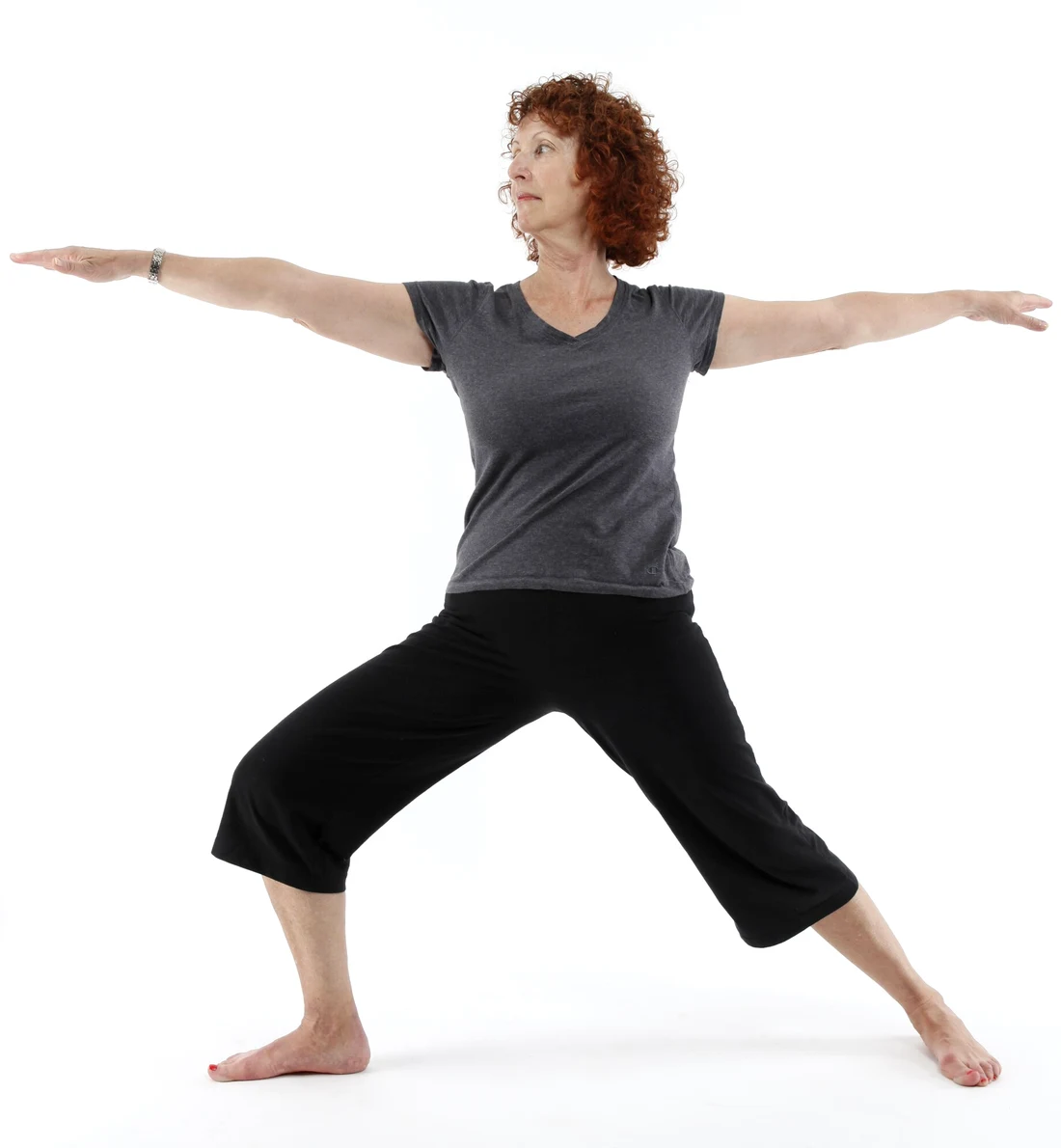
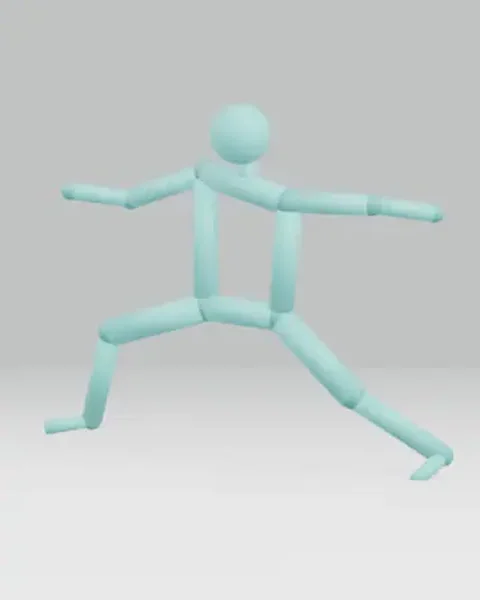
The pose as most people first meet it. By the end of this unit you should be able to say what is right about it, what you would cue, and what would change in a different body.
Listen to this unit
90 seconds, narrated. Candidates can have any unit read aloud — in their own cloned voice, if they opt in.
1 · What the pose is for
Function before shape
A teacher who can only describe a pose cannot teach it. A teacher who knows what it is for can teach it to a body that will never make the picture.
Warrior II does three things, and only the first is obvious.
1 · Isometric endurance in the front leg
The quadriceps and glutes hold a fixed length under load. This is why the pose feels long before it feels hard, and why it belongs in the middle of a class rather than at the start.
2 · External rotation of the front hip against a stable pelvis
The femur rotates outward while the pelvis stays where it is. Nearly every visible error in this pose is the pelvis giving up that job.
3 · Time — for you, the teacher
It is a held shape. It buys you the one thing a flowing sequence never gives you: a room that is still long enough for you to actually look at it. That is not a benefit for the student. It is a tool for you.
Assessment note: "it opens the hips" is marked wrong. That describes a sensation, not a function.
2 · From one photograph
How this lesson was made
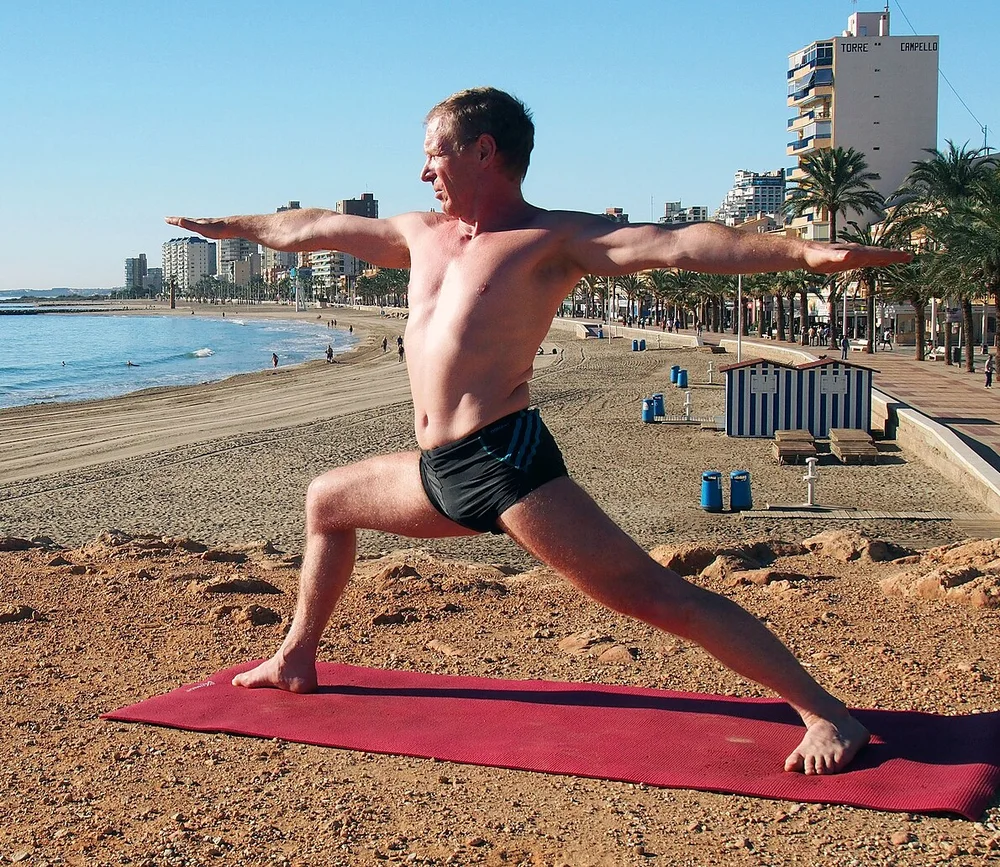
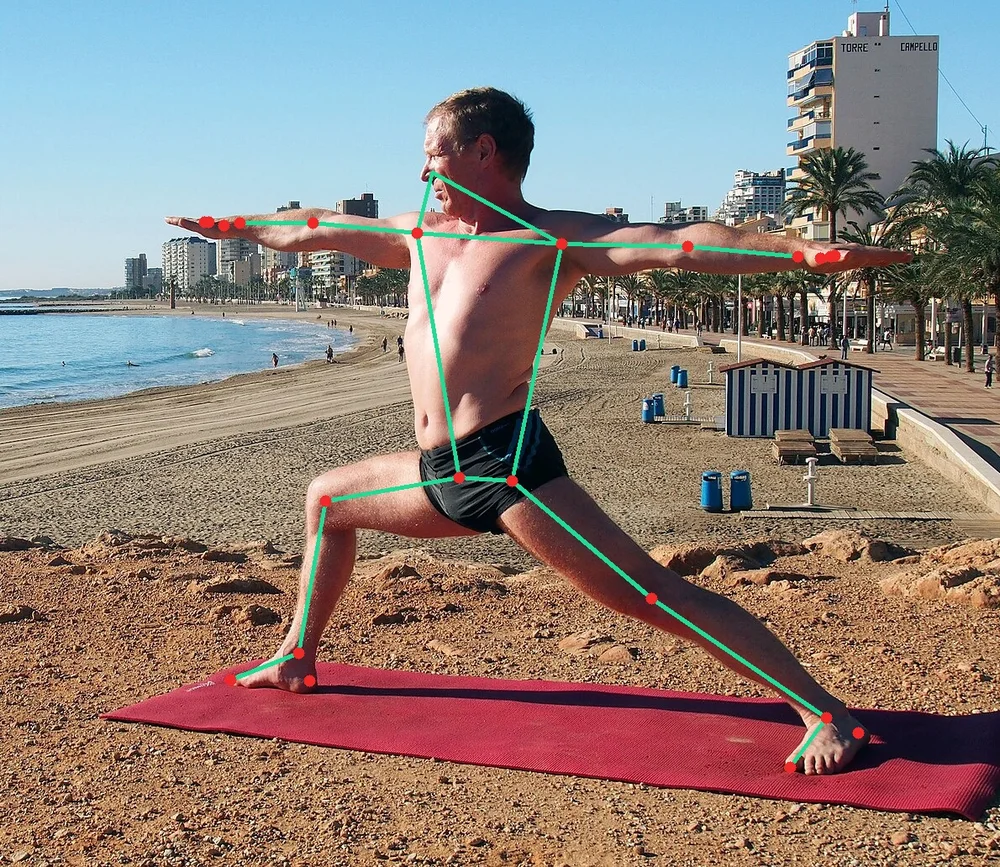
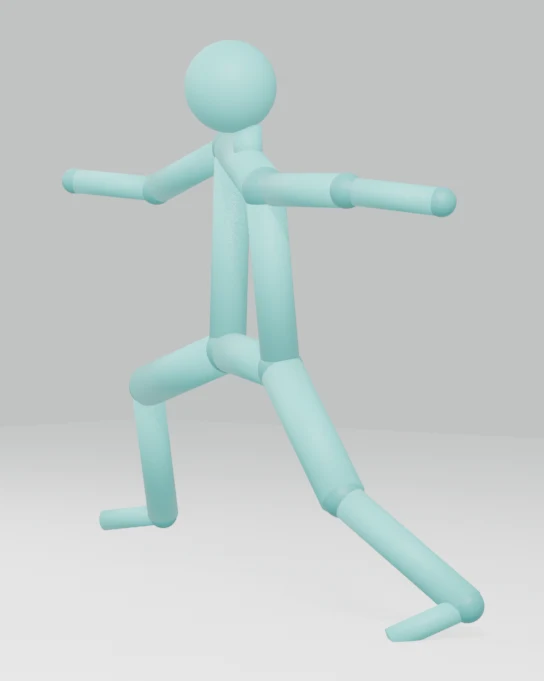
We filmed and photographed a real practitioner, extracted the pose, and rebuilt it as a model. That means the geometry comes from a real body rather than an artist's idea of one — and once it is a model, we can show you things a photograph cannot.
Step 1 — the photograph
Three steps, and you can see each one
A real practitioner, photographed once. Every claim in this unit about where the knee sits and what the pelvis is doing traces back to an actual body — not to a drawing.
Standing rule: no AI-generated images of bodies in poses. Anatomically wrong images in a program that teaches alignment are worse than no images.
3 · Any angle
Walk around it
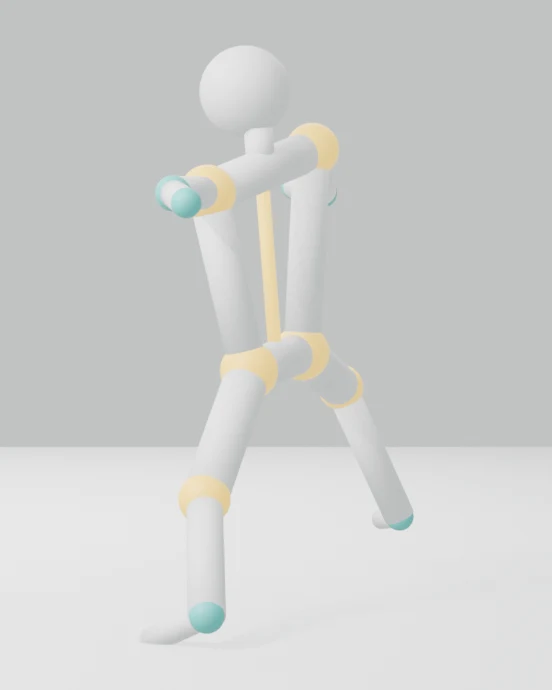
You will teach this pose from wherever you happen to be standing. Video gives you the angle the camera was on. Drag to turn the figure and check the back foot from behind, or the knee from the side.
3D · 36 angles
Drag to rotate ↔
What to look for as it turns
From the side: the front knee should stay behind the ankle. This is the view where you catch it collapsing forward — and it is invisible from the front, which is where most teachers stand.
From behind: the outer edge of the back foot stays grounded. When the arch lifts, the front knee follows it inward.
From above the shoulder: arms reach out from the centre of the chest, not up from the shoulders.
FrontSideBackFront
4 · Under the surface
Why the knee rule exists
A joint tolerates load well when the load passes through it and badly when it passes across it. That single sentence is the whole reason for the front-knee rule, and a teacher who understands it can reason about a pose they have never seen before.
Load-bearing joints
The six joints you are watching
Both knees, both hips, both shoulders — highlighted here. In a live room you cannot check twelve things at once, so the standard names six and asks you to see them in a moving body.
This is a joint-load layer, not a muscle atlas. Faculty review decides whether a full musculoskeletal overlay is worth building for every pose or only for the poses where it changes a teaching decision.
Load through joint centres. The front knee tracks toward the second toe so the load runs down the length of the shin. Let it drift inward and the same load now crosses the joint, taken up by the ligament instead of the bone.
Every anatomical claim in this unit traces to OpenStax Anatomy & Physiology or a cited source. Faculty review checks that specifically.
5 · Your body
The same pose, at your proportions
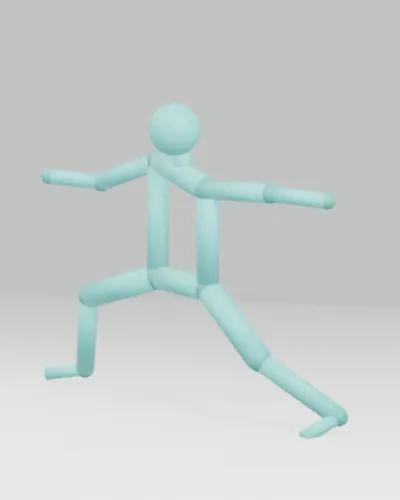
A long-femur body and a short-femur body cannot make the same Warrior II — and neither of them is doing it wrong.
This is the sixth principle of alignment: adapt the shape to the person while preserving the pose's function. Set the figure to your own build and watch the geometry change.
60 pre-rendered builds · one photograph
Height
Build
Legs, relative to torso
Stance width—
Front thigh—
Torso—
Teaching consequence: a student whose stance is narrower than the picture may be at the end of their range, not being lazy. Cue what the pose is for, not what it looks like.
6 · What goes wrong
Three errors, and the ten-word cue for each
Every unit names the most common errors and gives you language short enough to say while people are moving. A cue longer than about ten words does not land in a room.
7 · Check
Two questions that ask for judgment
Not recall. Both of these are the kind of item you have to be able to answer to be certified — and most candidates get the second one wrong the first time. That is intentional.
Question 1 of 2
A student's front knee keeps drifting inward. You have corrected it verbally twice and it keeps returning. What do you do next?
Correct. A cue that fails twice is usually aimed at the symptom. The knee is downstream of the foot — base before shape, the first principle of alignment. Fix the base and the knee follows without being mentioned again.
Not quite. Repeating a failed cue louder rarely works, hands-on correction here fixes the position for as long as your hand is there, and giving up skips the actual cause. The knee is following the back foot: the arch has lifted. Cue the base — base before shape — and the knee resolves on its own.
Question 2 of 2
Two students have a visibly narrower stance than everyone else. One is at the structural limit of their hip range; the other simply has not been cued into a wider stance. What tells them apart from across the room?
Correct — and this is the competency that separates a teacher from someone who has memorised poses. The breath is the governor: a body past its available range loses smooth breathing before anything else visible happens. Invite a little more range and watch the pelvis. If it tilts or rotates to buy the extra width, the hip has run out and the body is borrowing from somewhere else. That is a stop.
Not quite — and this is the item most candidates miss first time. Comfort is unreliable, because a body at its limit may look serene while a beginner with plenty of range looks miserable. Earlier poses load the hip differently. Asking is reasonable but does not scale to a room of thirty, and it will not be available to you online. What you actually read is the breath, plus whether the pelvis stays level when you invite more range. Breath goes first; a tilting pelvis means the hip has run out and the body is borrowing.
Question 2 is a knowledge item. The observed version — doing this in a live room while also teaching — is what the practicum assesses, and no candidate can test out of it.
That was one unit of roughly fifteen
Your path is assembled from a skills check, so it holds the units you need and skips what you can already demonstrate. Twelve weekly cycles, capped at 40 candidates, beginning October 1, 2026.
Every unit built like this one — any angle, the anatomy layer, your own proportions
Narrated in a voice you choose, including your own if you opt in
Assessment that asks you to make real teaching judgments
A recorded practicum that a named human being watches and writes back on
Nothing is charged today. Deposits open once the first modules have cleared faculty review.
Sample lesson, draft for review · Yoga.org certification · The 3D figure is derived from a photograph of a real practitioner and is deliberately a simple form: accurate geometry is worth more to a teacher than an impressive body that is subtly wrong.
Photographs: Warrior II by lululemon athletica, CC BY 2.0, via Wikimedia Commons · Rocket-yoga-06 by Lilian White, CC BY 4.0, via Wikimedia Commons; the 3D figure and all renders are derived from that work.